
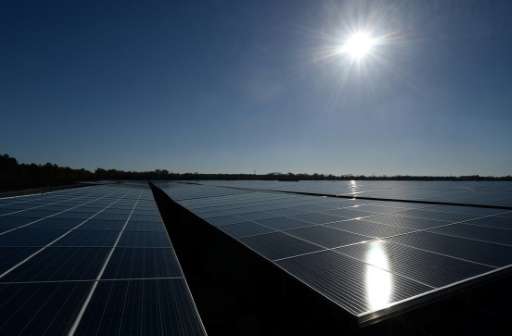
“We show strong downward trends of environmental impact” of solar panel production, the team wrote in the journal Nature Communications.
The study sought to address concerns that solar technology may be using fossil fuel energy in the panels’ manufacture, and emitting greenhouse gases, faster than it was able to offset.
The authors found that for every doubling in solar capacity installed, energy used to produce solar panels decreased by 12-13 percent, and greenhouse gas emissions dropped by 17-24 percent, depending on the material used.
Solar panels, which convert sunlight into electricity, are a key player in the fast-growing renewable energy sector, which also includes water- and wind-generated electricity.
Unlike energy from fossil fuels such as oil, coal and gas, the generation of electricity by so-called photovoltaic (PV) panels does not release planet-harming carbon dioxide.
Solar panel capacity grew sharply, on average, by 45 percent per year from 1975 to reach 230 billion watts (Gigawatt or GW) in 2015.
In 1975, there were fewer than 10,000 solar panels around the world, compared to about a billion today, study co-author Wilfried Van Sark of Utrecht University in the Netherlands told AFP.
By the end of 2016, “we would have some 300 GW installed”—about 1-1.5 percent of global electricity demand.
Falling costs
Over an average lifespan of 30-odd years, a PV system pays back the energy that was used in producing it “multiple times,” said the study authors.
Looking at data since 1976, the researchers calculated that on a global scale, solar energy’s “debt was likely already repaid in 2011” for both energy input and greenhouse gases.
Even on the least optimistic data, break-even point will be reached at the latest next year for net energy, and in 2018 for greenhouse gases, they said.
The photovoltaic effect, by which certain materials convert the photon particles in sunlight into energy, was first identified by French physicist Edmund Bequerel in 1839.
The first photovoltaic battery was built in 1954 but was too expensive for widespread use.
The technology was used in the 1960s to generate power on spacecraft, and only started taking root on Earth in the 1970s.
From 1975, costs decreased by about 20 percent for every doubling in capacity, the study found.
In 1976, one would have paid about $80 (75 euros at today’s rates) for one Watt-peak (Wp) unit, compared to about 64-67 US cents today.
Courtesy: PHYS.ORG